
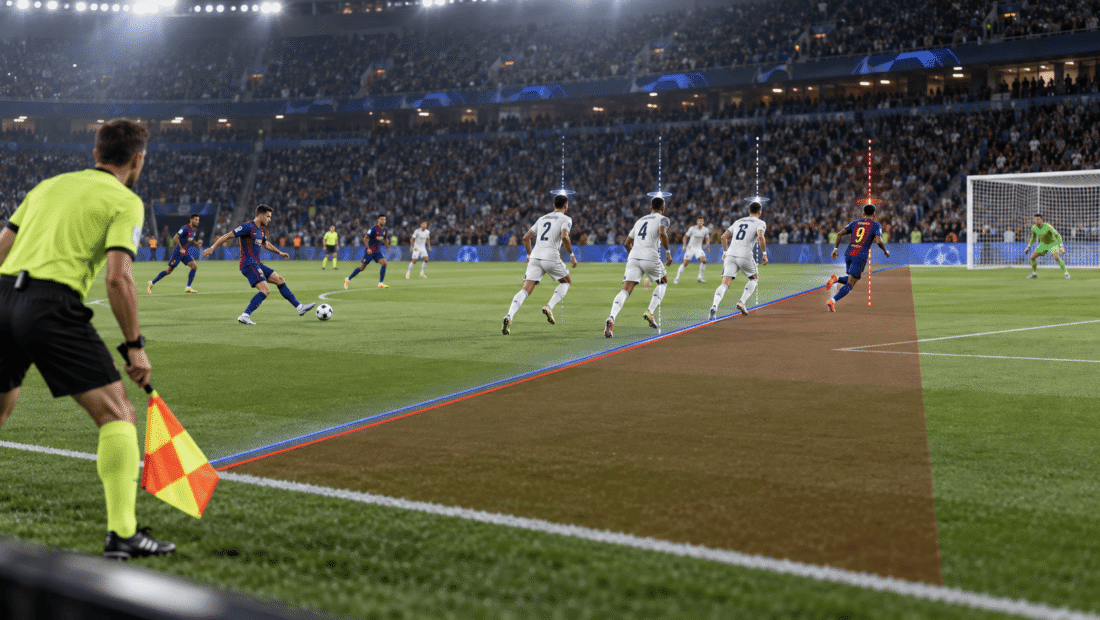
The offside rule in football is easier to understand once one important distinction is clear: standing in an offside position is not automatically an offence. A player can be beyond most of the defending team when a pass is made and still avoid being penalized if they do not become involved in active play. The referee has to consider both the player’s position at the relevant moment and what that player does afterward.
Under the current Laws of the Game, a player is in an offside position when part of the head, body or feet is in the opponents’ half and nearer to the opponents’ goal line than both the ball and the second-last opponent. Hands and arms do not count, and a player who is level with the second-last opponent is not in an offside position.
That sounds straightforward until a defender touches the ball, a goalkeeper makes a save, two attackers run toward the same pass or an offside player influences a defender without ever touching the ball. Those situations are why offside decisions can become some of the most debated moments in football. This guide breaks the rule into the individual decisions referees actually have to make.
What Is the Offside Rule in Football?
The offside law prevents attacking players from simply waiting next to the opposition goal for a forward pass. It creates a relationship between the attacker, the ball and the defending players at the moment a teammate plays or touches the ball.
An attacker is potentially offside only when the positional conditions exist. Even then, the referee does not immediately stop play simply because the attacker is standing beyond the defensive line.
The player must subsequently become involved in active play in a way recognized by Law 11.
This is why commentators carefully distinguish between an offside position and an offside offence. The first describes where the player is. The second describes a punishable action.
Understanding that difference solves many of the situations that initially appear inconsistent.
When Is a Player in an Offside Position?
A player can be in an offside position when three basic conditions come together.
First, some part of the player’s head, body or feet must be in the opponents’ half of the field. The halfway line itself does not place the player in an offside position.
Second, that playable part of the body must be nearer to the opponents’ goal line than the ball.
Third, it must also be nearer to the goal line than the second-last opponent.
Hands and arms are excluded when judging the position. IFAB defines the upper boundary of the arm for offside purposes in relation to the bottom of the armpit. A player who is exactly level with the second-last opponent, or with the last two opponents, is onside.
The phrase second-last opponent is particularly important because the rule does not actually say “last defender.”
Why Being in an Offside Position Is Not Automatically an Offence
A player can stand in an offside position without committing any offence.
Imagine a winger passes the ball across the field to another teammate who was onside. A striker is standing beyond the defensive line on the opposite side but makes no attempt to play the ball, does not challenge a defender and does not affect the goalkeeper.
That striker may have been in an offside position when the pass was played, but position alone does not require the referee to stop the match.
If play continues and the striker later returns to an onside position before receiving a new pass from a teammate, that second phase is judged from the moment of the new pass.
This is an important part of modern attacking play. Players can temporarily find themselves offside without the attack automatically ending.
The offence occurs only when the player becomes involved according to the conditions defined in Law 11.
The Moment Offside Is Judged
Offside position is generally determined at the moment a teammate plays or touches the ball, not when the receiving attacker eventually controls it.
This matters particularly for through balls.
A forward may look several meters beyond the defense by the time the ball reaches them, but the relevant image is the instant the teammate played the pass. If the forward was level with the second-last opponent at that moment and then accelerated beyond the defensive line, the run can be perfectly legal.
The reverse can also happen. An attacker may run back toward midfield and receive the ball while appearing comfortably onside, but if the player was in an offside position when the teammate originally played it, an offence can still occur when the attacker becomes involved.
Under the current Law 11 wording, the first point of contact is used when determining the timing of a teammate’s play or touch. An exception applies when the goalkeeper throws the ball: the last point of the goalkeeper’s contact is used. That goalkeeper-throw clarification was introduced in the 2025/26 law changes and remains reflected in the current Law 11 text.
What Does Interfering with Play Mean?
The simplest offside offence occurs when a player who was in an offside position plays or touches a ball that was passed or touched by a teammate.
Imagine a midfielder plays a through ball and the striker was beyond the second-last opponent at the relevant moment. If the striker receives and controls the pass, the decision is straightforward: the player has interfered with play.
The attacker does not need to score, shoot or even retain possession for long. Playing or touching the ball can be enough.
A player can also be penalized after an accidental touch by a teammate. The teammate does not have to intend to make a perfect pass toward the offside attacker. Law 11 concerns a ball played or touched by the teammate and the subsequent involvement of the player who was in the offside position.
More complicated decisions arise when the attacker never touches the ball but affects an opponent.
Interfering with an Opponent Can Be Offside Without Touching the Ball
An attacker does not need to touch the ball to commit an offside offence.
Law 11 also covers situations in which a player in an offside position interferes with an opponent. That can include clearly obstructing an opponent’s line of vision, challenging an opponent for the ball or making an obvious action that clearly affects the opponent’s ability to play it.
A common example occurs in front of the goalkeeper.
Suppose an attacker in an offside position stands directly between the goalkeeper and a long-range shot. The attacker never touches the ball, but their position clearly prevents the goalkeeper from seeing the shot properly. The goal can be disallowed because the attacker interfered with the opponent.
The same logic can apply when an offside attacker moves toward a defender and challenges for the incoming ball.
The key question is not simply whether contact with the ball occurred. It is whether the offside player’s action had the required impact on the opponent.
Gaining an Advantage After a Rebound, Deflection or Save
Another important category involves a player gaining an advantage from having been in an offside position.
Suppose a teammate shoots while an attacker is offside. The ball strikes the goalpost and rebounds directly to that attacker, who scores.
The post does not create a new onside phase. The attacker can be penalized because the player gained an advantage from the earlier offside position.
A similar principle can apply when the ball is deflected by an opponent or when a goalkeeper or other defender makes a deliberate save.
This is why a goalkeeper touching the ball does not automatically reset offside.
If an attacker was offside when the teammate shot and the goalkeeper saves that shot into the attacker’s path, the original offside position can still matter.
Law 11 specifically distinguishes rebounds, deflections and deliberate saves from situations in which an opponent deliberately plays the ball under control.
Deliberate Play vs Deflection
This is one of the most difficult parts of the offside law.
A player in an offside position who receives the ball after an opponent deliberately plays it is generally not considered to have gained an advantage from that original position, unless the opponent’s action was a deliberate save.
But not every defensive touch counts as deliberate play.
IFAB’s guidance looks at whether the defender had control of the ball with the possibility of passing it, gaining possession or clearing it. Factors can include whether the ball came from a reasonable distance, whether the defender had a clear view, whether its direction was expected and whether there was enough time to coordinate the movement.
A defender stretching instinctively and barely deflecting a fast pass may not reset the offside situation.
A defender controlling the ball and then making an inaccurate clearance can be different. A poorly executed deliberate play can still be considered deliberate.
That distinction explains why similar-looking defensive touches can produce different offside decisions.
Why the Second-Last Opponent Matters
People often explain offside by saying an attacker must stay behind the “last defender.” That shortcut is not technically accurate.
The law refers to the second-last opponent.
Normally, the goalkeeper is the last opponent and an outfield defender is the second-last. In those ordinary situations, the simplified “last defender” explanation appears to work.
But goalkeepers do not have a special status in the offside calculation.
If the goalkeeper runs far from goal, two outfield defenders could become the last and second-last opponents. In another situation, only one opponent may remain between the attacker and goal.
The correct reference point is therefore always the second-last opponent, regardless of position.
Understanding this prevents confusion during unusual situations involving a goalkeeper who has left the penalty area.
Can You Be Offside in Your Own Half?
No.
A player must have part of the head, body or feet in the opponents’ half to be in an offside position.
That creates an important opportunity during counterattacks.
An attacker can stand extremely far ahead of the opposition’s defenders but remain onside if the attacker is still entirely within their own half when the teammate plays the ball.
The player can then sprint beyond the defenders and collect the pass.
This is another example of why the attacker’s position when receiving the ball can be misleading. By the time the pass arrives, the player may be close to the penalty area.
The relevant position was determined earlier, when the teammate played or touched the ball.
IFAB explicitly confirms that a player remaining in their own half is not in an offside position even if nearer to the opponents’ goal than both the ball and the second-last opponent.
When Offside Does Not Apply Directly
There are three important restarts from which a player cannot commit an offside offence by receiving the ball directly:
- a goal kick;
- a throw-in;
- a corner kick.
This exception is explicitly stated in Law 11.
That means an attacker can stand beyond the defensive line and directly receive a throw-in without being penalized for offside.
The same applies when receiving a ball directly from a corner kick or goal kick.
However, the exemption applies only to the direct receipt from that restart.
Once another teammate touches the ball, normal offside considerations can immediately return.
This difference is particularly important around corners, where the original taker may become offside during the next phase.
Offside Can Apply Again Immediately After a Restart
Being exempt from offside on the first touch after certain restarts does not make the entire attacking phase immune from the rule.
Imagine a player takes a corner kick and sends the ball to a teammate. There is no offside offence on that direct corner delivery.
The teammate then passes the ball back toward the original corner taker.
At the moment of that second pass, normal offside rules apply again.
If the corner taker has moved into an offside position and then plays the return pass, the referee can penalize the offence.
IFAB specifically uses this type of scenario in its official Law 11 guidance.
The same principle applies after a throw-in or goal kick. The special protection concerns receiving the restart directly, not everything that happens afterward.
How Goalkeepers Affect Offside Decisions
Goalkeepers frequently create confusion because many people assume the goalkeeper must always be one of the two opponents used for the offside line.
That is not required.
The law counts opponents, not positions.
If the goalkeeper is standing farther up the field than a defender, the goalkeeper may no longer be the last opponent. An attacker could then need two outfield opponents between themselves and the goal line to remain onside in relation to that part of the test.
Goalkeepers are also relevant when making saves.
If an offside attacker benefits from a goalkeeper’s deliberate save of a teammate’s shot, the save does not normally reset the offside situation. The attacker can still be penalized for gaining an advantage.
At the other end of play, when a goalkeeper throws the ball to begin an attack, current Law 11 uses the last point of contact with the ball to determine offside position.
What Happens When Offside Is Given?
When an offside offence occurs, the defending team receives an indirect free kick from the place where the offence occurred.
That location can surprise viewers.
A player might have been in an offside position when the teammate passed the ball from one area, then run backward before eventually playing it somewhere else.
The offence is associated with the location where the player becomes involved in active play.
Under Law 11, this can even mean the indirect free kick occurs within the player’s own half in an unusual situation where the attacker comes back from an offside position and interferes with play there.
Assistant referees traditionally indicate offside with the flag, while competitions using VAR can review applicable offside incidents around goals and other reviewable situations.
How VAR Changed the Way Offside Looks on Television
The underlying offside law did not become simply “VAR decides it.” The legal questions remain the same: where was the player at the relevant moment, and did that player then commit an offside offence?
Technology changes how closely that position can be examined.
Before video review, assistant referees had to judge extremely close situations in real time while simultaneously tracking the passer and the defensive line. That remains a demanding task because both events can be separated by significant distance.
Video review can allow close incidents connected with reviewable match situations to be examined after the play.
This is one reason assistants in competitions using VAR may sometimes delay the flag during a promising attack rather than immediately ending play in a very close situation.
The technology may help assess position, but interpretive questions such as interference with an opponent or whether a defensive action was deliberate can still require application of the law rather than measurement alone.
Common Offside Examples
Consider a simple through ball. The striker is level with the second-last opponent when the midfielder plays the pass, then immediately runs behind the defensive line. The striker is onside because being level at the relevant moment is legal.
Now change the situation slightly. The striker is already beyond the second-last opponent when the pass is played and then receives the ball. That becomes a straightforward offside offence.
In a third example, the striker is offside but stops running. An onside winger collects the pass and attacks. If the striker does not interfere with an opponent, play can continue.
In another situation, a player is offside when a teammate shoots. The goalkeeper saves the attempt and the ball rebounds directly to that player. Playing the rebound can result in offside because a deliberate save does not reset the earlier position.
Finally, imagine a defender clearly controls an attempted pass but mishits the subsequent clearance toward an attacker who had been standing offside. Depending on the facts, a genuine deliberate play by the defender can mean the attacker is not penalized for the previous offside position.
These examples show why the first question should always be what happened at the teammate’s touch, followed by what happened next.
Common Offside Myths
One common myth is that a player is offside simply because they are behind the defenders. Position alone is not an offence.
Another is that the goalkeeper defines the offside line. The law actually uses the second-last opponent.
A third misconception is that any touch by a defender resets offside. It does not. A deflection and deliberate play are treated differently, and deliberate saves remain a specific exception.
It is also incorrect to assume that attackers can never be beyond the defensive line during a throw-in. A player cannot be penalized for receiving the ball directly from a throw-in.
Finally, being behind the ball generally prevents the player from satisfying one of the positional requirements for offside. The offside test compares the attacker with both the ball and the second-last opponent, not defenders alone.
Understanding these distinctions makes many controversial-looking decisions much less mysterious.
How Attackers Beat the Offside Line
The best attacking runs are often about timing rather than pure speed.
A forward wants to remain onside until the teammate begins the pass and then accelerate into the space behind the defense.
Starting too early can waste an excellent move. Starting too late allows defenders to recover.
Attackers also use curved runs. Instead of sprinting directly toward goal, the player can bend the run across the defensive line to delay crossing into an offside position.
Another technique is beginning from a slightly deeper position and attacking the space only after the passer receives time on the ball.
Communication matters as well. A midfielder looking up before the pass can help the forward anticipate exactly when the ball is likely to be released.
At elite level, the difference between an onside run and a disallowed goal can be the timing of a single step.
How Defenders Use the Offside Trap
Defenders can use the law proactively by moving forward together immediately before an attacking pass.
If timed correctly, the movement leaves an attacker in an offside position when the teammate plays the ball.
This is commonly described as the offside trap.
The tactic depends heavily on coordination. If one defender remains deeper than teammates, that player can keep the attacker onside and create a dangerous situation behind the rest of the defensive line.
Communication between center-backs, full-backs and goalkeeper is therefore essential.
The tactic can also be risky against fast attackers or opponents capable of delaying passes until the defensive line begins moving.
Modern defending often involves constant adjustment rather than one dramatic step forward. Defenders monitor the ball, nearby attackers and the positioning of teammates simultaneously.
How to Read an Offside Decision Like an Analyst
When a controversial replay appears, do not begin by looking at where the attacker eventually received the ball.
Start with the moment the teammate played or touched it.
Then identify the ball and the second-last opponent. Was the attacker nearer to the goal line than both? Was any relevant part of the head, body or feet in the opponents’ half?
If the answer indicates an offside position, move to the second question: what did the attacker actually do?
Did the player touch the ball? Challenge an opponent? Block the goalkeeper’s vision? Benefit from a rebound or save?
If a defender touched the ball, ask a third question: was it merely a deflection, a deliberate save or a genuine deliberate play under the law?
Following those steps explains far more than simply drawing a line across a freeze-frame.
Offside is ultimately a sequence of decisions: position, timing, involvement and the nature of any subsequent touch.
Frequently Asked Questions About the Offside Rule
What is offside in football?
A player can be in an offside position when part of the head, body or feet is in the opponents’ half and nearer to the goal line than both the ball and the second-last opponent. The player is penalized only if they then become involved in active play in a way defined by Law 11.
Is being in an offside position automatically a foul?
No. IFAB explicitly states that being in an offside position is not itself an offence. The player must subsequently become involved in active play.
Can you be offside if you are level with the defender?
A player who is level with the second-last opponent is not in an offside position.
Do arms count for offside?
No. The hands and arms of attackers and defenders, including goalkeepers, are not considered when determining offside position.
Can you be offside in your own half?
No. A player must be in the opponents’ half to satisfy the positional definition of offside.
Can you be offside from a throw-in?
There is no offside offence when a player receives the ball directly from a throw-in. Normal offside rules can apply again after another player touches the ball.
Can you be offside from a corner kick?
A player cannot be penalized for receiving the ball directly from a corner kick. Offside can apply during the next phase after another teammate plays or touches the ball.
Can you be offside from a goal kick?
No offside offence occurs when the player receives the ball directly from a goal kick.
Does a defender touching the ball cancel offside?
Not always. A genuine deliberate play by the opponent can change the situation, but a deflection or deliberate save does not automatically do so.
Does a goalkeeper save reset offside?
No. An attacker can still be penalized for gaining an advantage after a ball has been deliberately saved by an opponent.
Who is the second-last opponent?
The second-last opponent is simply the opponent who is second closest to their own goal line at the relevant moment. That player does not have to be an outfield defender because goalkeepers have no special status in this calculation.
When exactly is offside measured?
It is generally determined when the ball is played or touched by the attacker’s teammate. Current Law 11 uses the first point of contact, except for a goalkeeper’s throw, where the last point of contact is used.
Can you be offside without touching the ball?
Yes. A player in an offside position can be penalized for interfering with an opponent, including certain situations involving challenges, line of vision or an obvious action affecting the opponent’s ability to play the ball.
What is the punishment for offside?
The defending team receives an indirect free kick from the place where the offside offence occurred.