
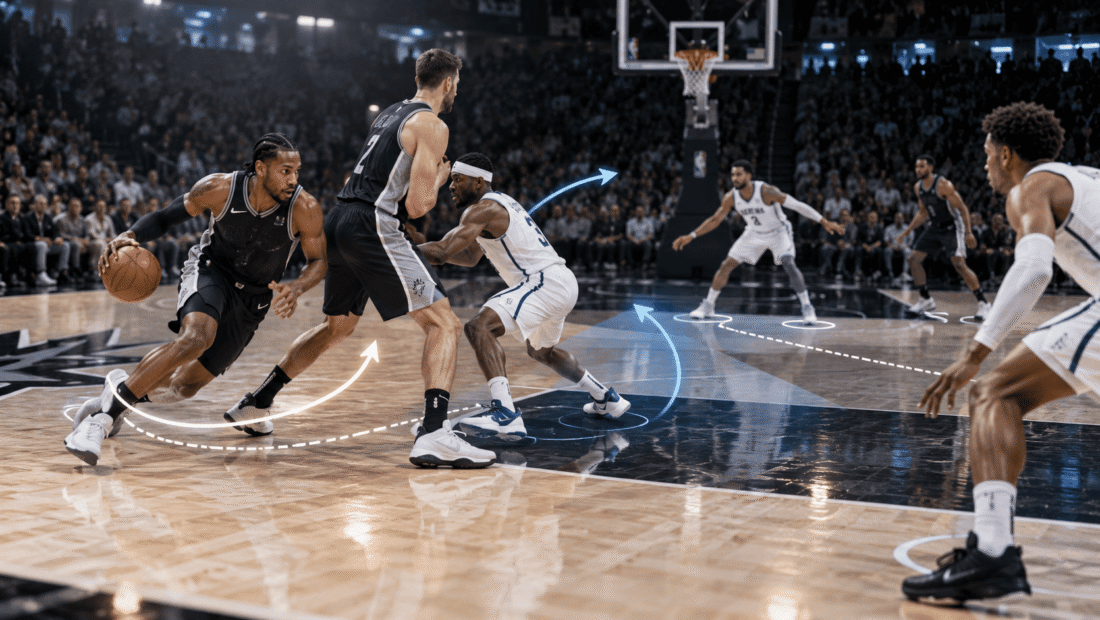
The pick and roll is one of basketball’s most important offensive actions because two players can force an entire defense to make decisions in only a few seconds. One player handles the ball while a teammate sets a screen on the defender guarding them. From that point, both offensive players react to how the defense responds. The screener may roll toward the basket, move outside for a shot or create space for another teammate, while the ball-handler can drive, pass or shoot.
The action appears simple, but its effectiveness comes from the number of possibilities it creates. Defenders must decide whether to switch assignments, stay close to the screener, retreat toward the basket or send additional pressure at the ball. Each response protects one area while potentially opening another. That is why the pick and roll remains central to modern NBA offense even though teams have been using screens for generations.
What Is a Pick and Roll?
A pick and roll begins with a screen, also called a pick.
The screener positions their body near the ball-handler’s defender, creating an obstacle the defender must navigate. The ball-handler then moves around the screen.
After setting it, the screener traditionally turns and moves toward the basket. That movement is the roll.
The defense now has to deal with two offensive threats moving in different ways: the ball-handler attacking with the ball and the screener moving toward the rim.
The simplicity of that basic two-player action creates the foundation for numerous variations.
Why the Screen Matters
The screen is designed to create separation.
A good screen forces the on-ball defender to take a longer route, momentarily placing them behind the play. Even a small delay can be enough for the ball-handler to attack open space.
Screen angle matters because it influences the direction available to the dribbler. The screener can position themselves to encourage the ball-handler toward the middle, sideline or another preferred area.
Timing matters as well.
If the ball-handler moves before the screener is established, the defender may avoid the screen entirely. If the screener arrives too early, the defense has more time to anticipate the action.
What the Ball-Handler Is Reading
The player with the ball is not simply waiting for the screen and driving automatically.
They are reading several defenders.
What is the on-ball defender doing? Where is the screener’s defender positioned? Is another defender leaving a shooter to help? Has the screener created a clear lane to the basket?
The correct decision can change from possession to possession.
A defender going under the screen may leave room for a jump shot. A defender chasing over may create a driving lane. Aggressive help can open a pass to the screener or a teammate away from the ball.
Great pick-and-roll players are dangerous because they process those decisions quickly.
What the Screener Does After Contact
The traditional option is to roll toward the basket, but modern screeners have several possibilities.
A strong finisher can sprint toward the rim and become a lob or interior passing target. A shooter can move away from the basket in a pick and pop. Another player can stop in the middle of the floor and operate through the short roll.
The screener may also change the angle of the screen before contact, sometimes called re-screening, if the defense positions itself to remove the original path.
This makes the screener an active decision-maker rather than simply an obstacle placed in front of the defender.
Why Drop Coverage Is Common
In drop coverage, the defender guarding the screener retreats toward the basket rather than stepping aggressively toward the ball-handler.
The goal is usually to protect the rim and contain the rolling big while the on-ball defender fights around the screen.
The trade-off is space in the middle of the floor.
A skilled ball-handler may be able to take a pull-up jump shot before reaching the deeper defender. If the defender steps forward, the roller can become open behind them.
Drop coverage therefore forces the offense to choose between several intermediate options rather than providing an obvious path directly to the rim.
How Switching Defends the Pick and Roll
When defenders switch, they exchange assignments after the screen.
The defender originally guarding the screener takes the ball-handler, while the on-ball defender moves onto the screener.
This can prevent immediate separation because neither offensive player is left unguarded.
The drawback is the possibility of a mismatch.
A quick guard may attack a larger defender on the perimeter, while a strong center can attempt to post up a smaller guard after the switch.
Teams with versatile defenders can switch more comfortably because the mismatch becomes smaller.
What It Means to Go Over or Under a Screen
The on-ball defender has to choose a path around the screen.
Going over means following the ball-handler closely around the screener, usually attempting to prevent an easy pull-up shot.
Going under means passing behind the screener.
That route can make it easier to protect against penetration but may leave shooting space.
The decision depends on the offensive player. Defenders are more willing to go under against players who are less dangerous from outside, while strong shooters can punish that approach.
These decisions are often part of the game plan rather than improvised on every possession.
What Is a Hedge or Show?
A hedge occurs when the screener’s defender steps toward the ball-handler temporarily rather than remaining deep.
The objective is to slow the dribbler while the original defender recovers.
After showing toward the ball, the big defender attempts to return to the screener.
This requires timing and mobility.
If the hedge lasts too long, the screener may become open near the basket. If the big retreats too quickly, the ball-handler can regain the advantage.
The technique tries to disrupt the action without committing fully to a switch.
What Is a Pick-and-Roll Trap?
A more aggressive defense can send both defenders at the ball-handler.
This is often described as a trap or blitz.
The intention is to force the ball out of the hands of a dangerous creator.
The risk is obvious: two defenders are now occupied by one offensive player.
If the ball-handler makes the pass successfully, the offense can temporarily attack four against three elsewhere on the floor.
This is where the screener’s passing ability becomes particularly valuable.
What Is the Short Roll?
Instead of moving all the way to the basket, the screener can receive the ball in the middle area after the defense pressures the ball-handler.
This is the short roll.
From there, the player may have several options: finish, make a short jump shot, pass to a cutter or find an open shooter.
The action becomes especially dangerous when the screener is comfortable making decisions with the ball.
A traditional center who can only finish at the rim may be easier to defend than a player capable of becoming a secondary playmaker after the screen.
Pick and Roll vs Pick and Pop
The key difference comes from what the screener does.
In a pick and roll, the screener moves toward the basket.
In a pick and pop, the screener moves away from the basket into shooting space.
A big player who can shoot effectively forces the defense into a difficult choice. Retreating protects the rim but may leave the pop open. Staying close to the shooter can create more room for the ball-handler.
Modern offenses frequently use both actions with the same players, making the defensive read less predictable.
Why Spacing Is Essential
A pick and roll does not involve only two offensive players.
The locations of the other three players can determine whether the action succeeds.
If teammates stand too close to the screen, their defenders can help without giving up much. Proper spacing forces defenders to travel greater distances if they want to support the pick-and-roll coverage.
Shooters positioned around the perimeter can punish defenders who collapse toward the ball.
Cutters can attack open space behind that help.
The two-player action is therefore most effective when all five offensive players create useful spacing.
What Weak-Side Defenders Are Doing
The weak side generally refers to the area away from the primary ball action.
Defenders there still play a major role in stopping the pick and roll.
A weak-side defender may move toward the paint to protect the rim if the screener rolls. Another defender may rotate toward the shooter that helper leaves behind.
This creates a chain reaction.
The offense tries to move the ball faster than the defense can rotate. The defense tries to help without giving up an uncontested shot.
Many apparently simple corner three-pointers actually begin with the advantage created by a pick and roll on the opposite side.
Why the Pick and Roll Creates Mismatches
Screens can deliberately force defenders into uncomfortable assignments.
If a defense switches, an offense may search for the weakest perimeter defender and involve that player in repeated screens. The objective is to force a favorable one-on-one matchup.
Teams can also screen with smaller players to create unusual switches or use guards as screeners when defenders are not accustomed to communicating through those actions.
This is sometimes called matchup hunting.
The pick and roll therefore functions not only as a direct scoring play but as a tool for changing who guards whom.
How Teams Disguise the Pick and Roll
Professional offenses rarely run every ball screen from a stationary setup.
A pick and roll can begin after a pass, handoff, cut or off-ball screen. A screener can approach from an unexpected angle. The offense can also reject the screen entirely if the defense anticipates the action.
These variations force defenders to communicate while moving.
By the time the recognizable pick and roll actually starts, the defense may already be slightly out of position.
That is why understanding basketball tactics requires watching what happens before the screen as well as after it.
Common Pick-and-Roll Mistakes
Poor spacing is one of the most damaging problems because it allows multiple defenders to crowd the same area.
An illegal or badly timed screen can also eliminate the action before it begins.
The ball-handler can make mistakes by attacking before the screen develops, picking up the dribble too early or missing an open teammate when defensive help arrives.
Screeners can roll into occupied space or move too slowly to create pressure on the defense.
Successful pick-and-roll offense depends on synchronization between all five players even though only two initiate the action.
How Statistics Can Describe Pick-and-Roll Offense
Traditional box-score statistics do not capture every part of the pick and roll.
The ball-handler may receive an assist if the roller scores, but another possession can create an open corner shot through two additional passes and give neither original player obvious statistical credit.
Efficiency data based on play type can provide more context, but even those numbers require interpretation because personnel, opponent and sample size matter.
The most useful analysis combines statistics with film or live observation.
Numbers can show that an action is producing efficient possessions. Watching the possessions can explain how those opportunities are being created.
Why Pick and Roll Dominates Modern Basketball
The pick and roll remains popular because it creates a simple problem with many possible answers.
The defense has to communicate instantly. A small mistake in positioning can create a driving lane, open shot or favorable mismatch.
For the offense, the action puts the ball in the hands of a decision-maker while forcing another defender to become involved.
Modern shooting makes it even harder to defend because help defenders cannot always leave perimeter players without consequences.
As long as teams can combine skilled ball-handlers, effective screeners and strong spacing, the pick and roll will continue to shape high-level basketball offense.
How to Watch the Pick and Roll Like an Analyst
Instead of following only the ball-handler, watch the screener’s defender.
That player often reveals the entire defensive strategy.
Are they dropping toward the basket? Stepping toward the ball? Switching onto the guard? Trapping aggressively?
Then watch the weak-side defenders.
If one moves toward the roller, somebody else may become open. If nobody helps, the roller may receive the ball near the rim.
Once these relationships become visible, NBA possessions become much easier to understand. What initially appears to be a simple screen becomes a sequence of decisions made by all ten players on the floor.
Frequently Asked Questions About the Pick and Roll
What is a pick and roll in basketball?
It is an offensive action in which one player sets a screen for the ball-handler and then commonly moves toward the basket.
Why is it called a pick?
A screen is also traditionally called a pick because the screener obstructs the defender’s preferred path within the rules.
What is the roll?
The roll is the screener’s movement toward the basket after setting the screen.
What is a pick and pop?
Instead of rolling toward the basket, the screener moves into open shooting space.
What is drop coverage?
The screener’s defender retreats toward the basket while the on-ball defender attempts to recover around the screen.
What is switching?
The two defenders exchange assignments after the screen.
What does going under a screen mean?
The defender moves behind the screener rather than following the ball-handler over the top.
Why would a defender go under?
It can protect driving space but may concede an outside shot, making it more suitable against weaker shooters.
What is a pick-and-roll trap?
Both defenders pressure the ball-handler after the screen, attempting to force a pass or turnover.
What is a short roll?
The screener receives the ball in the middle of the floor rather than rolling directly to the rim.
Why is spacing important?
Spacing makes it harder for other defenders to help without leaving shooters or cutters open.
Can guards set screens?
Yes. Guards and other smaller players can screen to force particular defensive switches or create mismatches.
Is the pick and roll only used in the NBA?
No. Ball-screen actions are used throughout basketball at many competitive levels.
What should I watch during a pick and roll?
Watch the screener’s defender, the path taken by the on-ball defender and the movement of weak-side help defenders.