
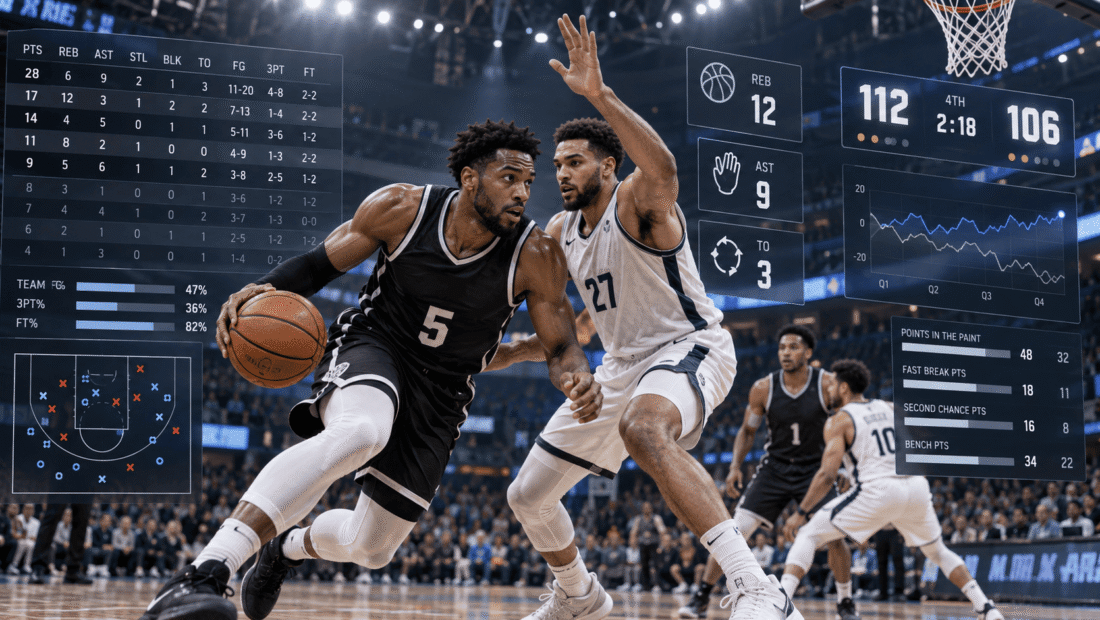
An NBA box score can summarize an entire basketball game on one page, but the largest number is not always the most important one. A player can score 30 points and still have an inefficient offensive night, while another can influence the result through defense, rebounding and playmaking without appearing near the top of the scoring column.
Understanding a box score means reading the statistics together rather than evaluating players or teams through one category. Points, shooting efficiency, rebounds, assists, turnovers and minutes each describe part of the game, while the context around those numbers determines what they actually mean.
Points Tell You Production, Not Efficiency
Scoring is the easiest statistic to notice because the objective of basketball is to produce more points than the opponent. But point totals do not show how efficiently those points were created.
A player scoring 25 points on a relatively small number of attempts may have contributed differently from a player who needed many more shots to reach the same total. Free throws and three-point shooting can also change the relationship between points and field-goal attempts.
That does not mean high-volume scoring is automatically inefficient. Some players are asked to create difficult shots because their team lacks other offensive options. Usage and role matter.
Field-Goal Percentage Needs More Detail
Traditional field-goal percentage combines two-point and three-point attempts even though those shots have different values. A player who makes five three-pointers contributes more points than someone making five two-pointers from the same number of attempts.
This is one reason basketball analysis often looks beyond simple FG%. Three-point percentage and overall shot distribution provide additional context, while more advanced efficiency measures can combine different scoring methods into a broader picture.
For an everyday reader, the main lesson is straightforward: do not assume the player with the highest field-goal percentage necessarily had the strongest offensive game.
Rebounds Depend on Role and Position
Rebounding totals help show who secured missed shots, but they also depend heavily on where a player operates. Centers and power forwards naturally spend more time close to the basket, while guards may collect defensive rebounds as part of a strategy designed to start transition quickly.
Offensive rebounds can be particularly valuable because they extend possessions and create another opportunity to score. Defensive rebounds usually end the opponent’s possession, provided the ball is secured cleanly.
Team rebounding can often be more informative than an individual total, especially when one side consistently creates second-chance opportunities.
Assists Show Creation but Not Every Good Pass
Assists provide a useful measure of playmaking, but they do not capture every action that creates an advantage. A player can make the pass that breaks the defense before a teammate makes the final assist, or attract multiple defenders and create an open shot without receiving statistical credit.
Assist totals are still valuable when combined with turnovers because they help show how effectively a player handled offensive responsibility.
A guard with high assists and relatively few turnovers may have controlled the game differently from a scorer who created points primarily through individual shooting.
Turnovers Can Change a Game Quickly
Every turnover gives away a possession and can create transition opportunities for the opponent. A team can shoot efficiently and still lose if it consistently gives the ball away.
The raw turnover number should still be interpreted in context. Players who handle the ball constantly or attempt difficult passes naturally face more turnover risk than low-usage players.
What matters is whether the mistakes were balanced by productive creation and whether the opponent converted those turnovers into easy points.
Plus-Minus Is Useful but Easy to Misread
Plus-minus records how the scoreboard changed while a particular player was on the court. If a player finishes at +12, their team outscored the opponent by 12 points during that player’s minutes.
The statistic can provide useful clues, but it should not be treated as an individual rating. Basketball is played five-on-five, which means plus-minus is heavily affected by teammates, opponents, rotations and short scoring runs.
A reserve can have an excellent plus-minus because the second unit dominated, while a star can finish negative after playing most of their minutes against the opponent’s strongest lineup.
It works better as a starting point for asking what happened during those minutes than as proof that one player was better than another.
Minutes Explain Opportunity
Minutes are one of the most overlooked statistics in a box score. A player cannot accumulate points, rebounds or assists while sitting on the bench, so playing time provides essential context for every counting statistic.
A reserve scoring 14 points in 18 minutes may have had a highly productive role even though a starter finished with a larger total. Similarly, a player returning from injury may produce modest numbers because the coaching staff deliberately limited their workload.
Changes in minutes can also reveal rotation decisions. If a usual starter plays significantly less than expected, the reason may involve foul trouble, injury, matchup or coaching choice.
Team Stats Often Explain the Result Better
Individual performances attract attention, but many games are decided by team-level differences. Turnovers, offensive rebounds, three-point shooting and free throws can create extra possessions or significant scoring swings.
A team that shoots slightly worse overall can still win by taking more shots because it collected offensive rebounds and protected the ball. Another may dominate inside but lose because the opponent created a large advantage from three-point range.
Looking at both team totals before focusing on individual players can therefore make the final score easier to understand.
Box Scores Need Game Context
Statistics become most useful when combined with what happened on the court. A player scoring heavily in the fourth quarter of a close game had a different impact from one accumulating points after the outcome was effectively decided.
Foul trouble can reduce minutes. Injuries can change rotations. Overtime adds additional playing time and can inflate counting totals compared with a regulation game.
The box score tells you what was recorded; the match report and analysis explain when and why those numbers mattered.
Use the Numbers to Ask Better Questions
The purpose of reading an NBA box score is not to find one statistic that identifies the player of the game. It is to understand how scoring, possession, efficiency and rotation combined to produce the result.
Start with the team score, then look at shooting, turnovers and rebounding. After that, individual points, assists, minutes and other statistics become easier to interpret in context.
The best basketball analysis uses the box score as evidence, not as a replacement for watching or understanding the game.