
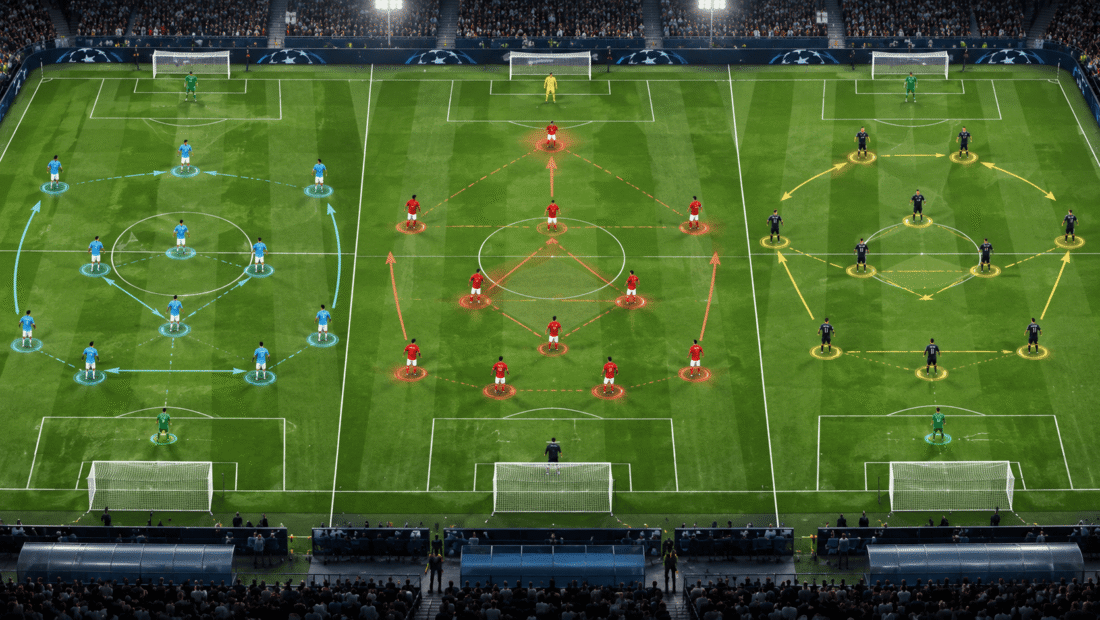
Football formations provide a simple way to describe how a team organizes its outfield players, but the numbers shown before kickoff rarely explain everything that happens once the match begins. A team listed in a 4-3-3 formation may defend as a 4-5-1, build attacks with three defenders and push both full-backs into midfield. Another team starting in a 3-5-2 can drop its wing-backs so deep without the ball that the structure resembles a back five. The formation is therefore best understood as a starting map of player relationships rather than a rigid arrangement maintained for 90 minutes.
Learning the most common football formations makes match analysis easier because shape influences how teams create width, protect central areas, press opponents and move from defense into attack. The same formation can also produce completely different football depending on the players selected and the instructions they receive. A 4-3-3 built around possession can look very different from a 4-3-3 designed for direct counterattacks, even though both appear identical on a lineup graphic.
What Does a Football Formation Actually Tell You?
A formation normally describes how the ten outfield players are arranged across defense, midfield and attack. In a 4-3-3, for example, the numbers indicate four defenders, three midfielders and three forwards. Goalkeepers are usually omitted because every conventional lineup already includes one.
That description is useful because it provides an immediate picture of the team’s starting structure. It can suggest how many central midfielders are available, whether traditional wingers are likely to play and whether a team begins with two central forwards or one. What it cannot tell you is exactly where each player will stand during every phase of play.
Modern teams constantly reshape according to possession, field position and opposition behavior. The more useful analytical question is therefore not simply “What is the formation?” but “What does this shape become when the team attacks, defends and transitions?”
Why Formations Change During the Same Match
A football team normally has several shapes rather than one. The structure used while building from the goalkeeper can differ from the formation used near the opposition penalty area, and both can differ again from the defensive block.
A nominal 4-2-3-1 might become a 3-2-5 in possession if one full-back moves centrally while the other advances. When possession is lost, the same side could recover into a 4-4-2 pressing structure before eventually settling back into a 4-5-1.
These changes are not necessarily formal substitutions or formation switches. They can emerge naturally from player roles.
This is why formation graphics are useful before kickoff but should never replace observation once the game begins.
How the 4-3-3 Formation Works
The 4-3-3 is one of the most recognizable football formations. It normally features four defenders, three central midfielders and a front line consisting of one central forward with two wider attackers.
One of its main strengths is natural width. The wingers can stretch the opposition horizontally, creating more space between defenders and opening central passing lanes. The three midfielders can also be arranged in different ways. Some teams use one deeper midfielder with two players positioned higher, while others create a flatter midfield line or rotate frequently between positions.
The formation can support aggressive pressing because the front three are naturally positioned to pressure several areas of the opposition build-up. However, pressing effectively depends on coordination. If the front line attacks while the midfield remains too deep, large spaces can open between the units.
Its flexibility is why two teams using 4-3-3 can still produce completely different tactical approaches.
How the 4-2-3-1 Formation Works
The 4-2-3-1 usually places two central midfielders behind an attacking midfielder, with two wide attackers supporting one striker. On paper, the double midfield base can provide additional protection in front of the defense while allowing the central attacking midfielder to operate between opposition lines.
The structure can be especially useful for teams with a specialist creator in the No. 10 role. That player can receive in spaces behind the opposing midfield and connect attacks with the striker or wide players.
The two deeper midfielders do not need to perform identical jobs. One may remain positionally disciplined while the other advances or carries the ball forward. Their relationship can determine whether the team controls central areas or becomes vulnerable when possession is lost.
Without the ball, the formation frequently resembles 4-4-2 if the attacking midfielder moves alongside the striker during pressing. In a deeper defensive phase, the wide attackers can drop and create a compact midfield line.
How the 4-4-2 Formation Works
The traditional 4-4-2 uses two banks of four behind two forwards. Its reputation for simplicity can be misleading because maintaining compact distances between those lines requires considerable tactical discipline.
With two strikers, the team can pressure opposing central defenders directly while retaining an immediate threat during transitions. The midfield four also provides natural coverage across the width of the pitch.
Problems can emerge centrally if two midfielders face an opponent using three or more players in the middle. Coaches can compensate by asking a striker to drop, moving a wide midfielder inward or defending in a narrower shape.
The 4-4-2 remains relevant partly because it can provide clear defensive responsibilities. It is also commonly seen as a defensive or pressing shape even when the same team attacks in a completely different formation.
How the 3-5-2 Formation Works
A 3-5-2 begins with three central defenders, wing-backs on either side, three central midfielders and two forwards. The structure can provide considerable strength through the center while still creating width through the wing-backs.
Those wing-backs are among the most important players in the formation because they may need to contribute in both attack and defense across large areas of the pitch. When they advance, the team can effectively attack with five players. When they retreat, the defensive structure can become a back five.
The midfield three also creates tactical flexibility. One player can hold while two advance, or two can remain deeper behind a more attacking midfielder.
The presence of two strikers gives the team several options for direct play, combinations and pressing, but the system can become vulnerable in wide areas if wing-backs are caught too high and the outside central defenders are forced into difficult one-on-one situations.
How the 3-4-3 Formation Works
The 3-4-3 combines a three-player defensive line with two central midfielders, two wing-backs and three forwards. It can create an aggressive attacking structure because five players naturally occupy advanced or wide positions.
The front three can stretch an opposing back line, while wing-backs provide additional width or overlap around the wide forwards. This can create difficult decisions for defenders: follow the winger inside, track the wing-back outside or protect the central area.
The potential weakness is central midfield. With only two nominal midfielders, a team can become outnumbered against opponents who overload the center unless forwards or defenders step into those spaces.
Modern versions of 3-4-3 often solve this through positional rotations, with one defender carrying the ball forward or a winger moving into midfield during possession.
How the 4-1-4-1 Formation Works
The 4-1-4-1 places one defensive midfielder between the back four and a midfield line of four. The structure can provide strong central protection while still allowing multiple players to support attacks.
The deepest midfielder often becomes crucial because that player protects spaces in front of the defense and provides an outlet during possession. If opponents can isolate or bypass that role, the defensive line can become exposed.
When attacking, the formation can resemble a 4-3-3 as wide midfielders push forward and central midfielders occupy more advanced positions. When defending, the midfield five can make central progression difficult.
As with most formations, the apparent numbers hide considerable movement.
Why a Back Three Can Become a Back Five
One of the most common misunderstandings in tactical discussions is assuming that three central defenders automatically means an attacking formation.
When wing-backs retreat alongside the central defenders, the team effectively creates a five-player defensive line. This can happen because of deliberate strategy or because the opposition forces the wing-backs deeper.
A 3-5-2 can therefore become 5-3-2, while a 3-4-3 can defend as 5-4-1.
The distinction matters when judging performance. A coach may intend to press aggressively with wing-backs high, but sustained opposition possession can push those players backward and dramatically change the appearance of the system.
Formation and territory therefore need to be analyzed together.
Why Midfield Shape Matters More Than the Numbers Suggest
Central midfield is often where formations become most difficult to describe through a simple number sequence.
Three midfielders can form a triangle with one player deeper or with two sitting behind one. A double pivot can play side by side or stagger vertically. One midfielder can drift toward the wing while another enters the penalty area.
These details determine passing angles and defensive coverage.
A numerical advantage in midfield can help a team circulate possession, but having more players in the area does not automatically create control. Positioning, technical ability and pressure from the opponent all affect whether the advantage can actually be used.
Watching the relationships between midfielders is therefore often more revealing than memorizing the formation name.
How Teams Create Width
Width forces defenders to cover more horizontal space.
Teams can create it through traditional wingers, attacking full-backs or wing-backs. Some systems keep the winger extremely wide while the full-back moves inside. Others do the opposite, with the winger occupying a narrow attacking position while the full-back overlaps.
This matters because central spaces often become available only after defenders have been stretched toward the touchline.
A team that becomes too narrow can make defending easier because opponents can remain compact. A team that stretches too far, however, may struggle to counterpress after losing possession.
Effective width is therefore about balance rather than simply placing players close to the sideline.
Full-Backs and Wing-Backs Can Transform a Formation
Few positions demonstrate modern tactical flexibility better than full-back.
A traditional full-back starts within a back four and normally contributes defensively before joining attacks from deeper positions. A wing-back generally operates higher and has greater responsibility for providing width in a system using three central defenders.
Modern teams complicate that distinction further. Some full-backs move into central midfield during possession, creating an extra passing option and helping protect against counterattacks. Others advance almost like wingers.
Because of this, the movement of full-backs can completely alter the team’s attacking formation without changing the official lineup.
When reading a match, tracking those players is one of the quickest ways to understand how the system actually works.
How Formation Affects Pressing
Pressing is not simply about running toward the player with the ball. Teams organize pressure to close certain passing lanes and encourage opponents toward areas where possession can be challenged.
Formation influences the starting positions of those pressing players.
A front three may pressure three defenders naturally, while two forwards in a 4-4-2 can attempt to block passes into midfield as they approach the center-backs. Midfielders then move according to those decisions.
Successful pressing depends on distances between the lines. If the front unit pressures aggressively while the midfield remains deep, the opponent can play through the gap.
The visible shape therefore matters most when it moves as a connected unit.
Low Blocks, Mid Blocks and High Presses
Defensive shape is also influenced by where the team chooses to engage the opponent.
A high press attempts to pressure possession closer to the opposition goal. A mid block allows some early progression before becoming compact around midfield. A low block protects space close to the defensive penalty area.
The same basic formation can be used at all three heights.
A 4-4-2 pressing high looks very different from a 4-4-2 defending near its own penalty box, even though the numerical structure has not changed.
This is why descriptions such as “defensive formation” can be too simplistic. The position and behavior of the block often tells more than the lineup numbers.
Why Transitions Can Expose Any Formation
A tactical system can appear perfectly organized when every player is in position, but football often becomes most dangerous immediately after possession changes.
When a team attacks, defenders and midfielders may move into aggressive positions. Losing the ball can expose the spaces they have vacated before the defensive structure has time to recover.
This phase is known as defensive transition.
The reverse situation occurs after winning possession. Opponents may be spread across the field, creating temporary spaces for counterattacks.
Formation still influences these moments, but recovery speed and positioning become more important than the static diagram.
Many goals that appear to be defensive mistakes are actually consequences of how the team was positioned several seconds earlier while attacking.
Tactical Matchups Between Different Formations
Formation becomes particularly interesting when two systems interact.
A 4-3-3 facing 4-4-2 may have an extra central midfielder but fewer players immediately close to the opposing center-backs. A 3-5-2 may overload the center against a two-player midfield while risking space behind its wing-backs.
These are tendencies rather than automatic advantages.
Individual players can change the matchup completely. A technically strong midfielder may handle numerical pressure, while a fast winger can punish a structure that appears secure on paper.
Coaches therefore adjust formations according to both the opponent’s system and the specific qualities of the players involved.
The tactical contest is about relationships, not diagrams competing against each other.
Why Coaches Change Formation During Matches
Managers can alter formation to solve problems or create new ones for the opposition.
A team chasing a goal may replace a defender with an attacker and move from a back four to a back three. A side protecting a lead may introduce another midfielder or defender to control central areas.
Some changes are less obvious. Moving one winger into a central position or asking a full-back to remain deeper can reshape the system without a substitution.
The timing of the adjustment matters.
A change made after the opponent has dominated for twenty minutes may be a response to a clear structural problem. A late attacking switch can simply reflect the scoreboard.
Strong match analysis explains what changed, why it changed and what happened afterward.
How to Read a Formation From the Lineup
Before kickoff, start by identifying natural positions rather than relying completely on the broadcaster’s graphic.
Look at how many recognized central defenders, full-backs, midfielders and forwards are selected. That provides clues about the likely starting shape.
Once the match begins, observe where players stand during goal kicks and sustained possession. Which defenders spread wide? Does a full-back move centrally? Who occupies the width? Which midfielder stays deepest?
Then look at the defensive shape.
The difference between those phases often reveals the real tactical structure more clearly than the announced formation.
Is There a Best Football Formation?
No formation is universally superior.
A system works when it suits the players, creates advantages against the opposition and provides enough defensive security for the team’s style. A theoretically sophisticated formation can fail if players do not have the required qualities, while a simple structure can be highly effective when responsibilities are clear.
Formations also evolve because opponents adapt.
Successful teams rarely rely on the shape alone. They rely on coordinated movement, technical quality and decisions within that structure.
This is why debates about whether 4-3-3 is “better” than 4-2-3-1 miss the more important question: what is each team trying to achieve with the players inside the formation?
How to Watch Football Formations Like an Analyst
The easiest way to improve tactical understanding is to stop watching only the ball.
Look at the players several meters away from the action. Notice how defenders move when their team has possession, where the deepest midfielder positions themselves and which player provides width.
Then compare that with the defensive phase.
Football formations are useful precisely because they provide a framework for those observations. They help organize what can otherwise look like constant random movement.
The formation tells you where the tactical story begins. Player roles, spacing and movement explain how it develops.
Frequently Asked Questions About Football Formations
What is the most common football formation?
Several formations are widely used in professional football, including 4-3-3, 4-2-3-1 and structures using three central defenders. Frequency varies between competitions, teams and tactical trends.
What does 4-3-3 mean?
It describes four defenders, three midfielders and three forwards, excluding the goalkeeper from the numerical notation.
What is the difference between 4-3-3 and 4-2-3-1?
The clearest difference is midfield organization. A 4-2-3-1 usually identifies two deeper midfielders behind a central attacking midfielder, while 4-3-3 generally organizes three central midfield roles differently.
Is 4-4-2 outdated?
No. Teams still use 4-4-2 either as their primary system or as a defensive and pressing shape.
What is a back three?
A back three refers to three central defenders forming the main defensive line, normally supported by wing-backs or wide midfielders.
What is a back five?
A back five usually occurs when two wing-backs or full-backs drop alongside three central defenders during the defensive phase.
What is a double pivot?
A double pivot describes two midfielders operating in deeper central positions and sharing responsibilities in build-up and defensive protection.
What is an inverted full-back?
An inverted full-back moves from a wide defensive position into central areas during possession, often functioning partly like a midfielder.
What is a wing-back?
A wing-back performs wide attacking and defensive duties in a system that commonly uses three central defenders.
Does formation determine playing style?
No. Identical formations can support possession football, counterattacking football, high pressing or deeper defending depending on player roles and instructions.
Why does a 4-3-3 sometimes look like a 3-2-5?
Players change positions during possession. One defender may move into midfield while attacking players occupy five advanced lanes, creating a different attacking structure.
Can a team change formation without making substitutions?
Yes. Coaches can change player positions and responsibilities using the same eleven players.
What formation is best for attacking football?
There is no universally best attacking formation. Effectiveness depends on player qualities, opposition structure and tactical execution.
What should I watch to understand a team’s formation?
Watch the team during sustained possession and during organized defense. Those two phases usually reveal much more than the pre-match lineup graphic.