
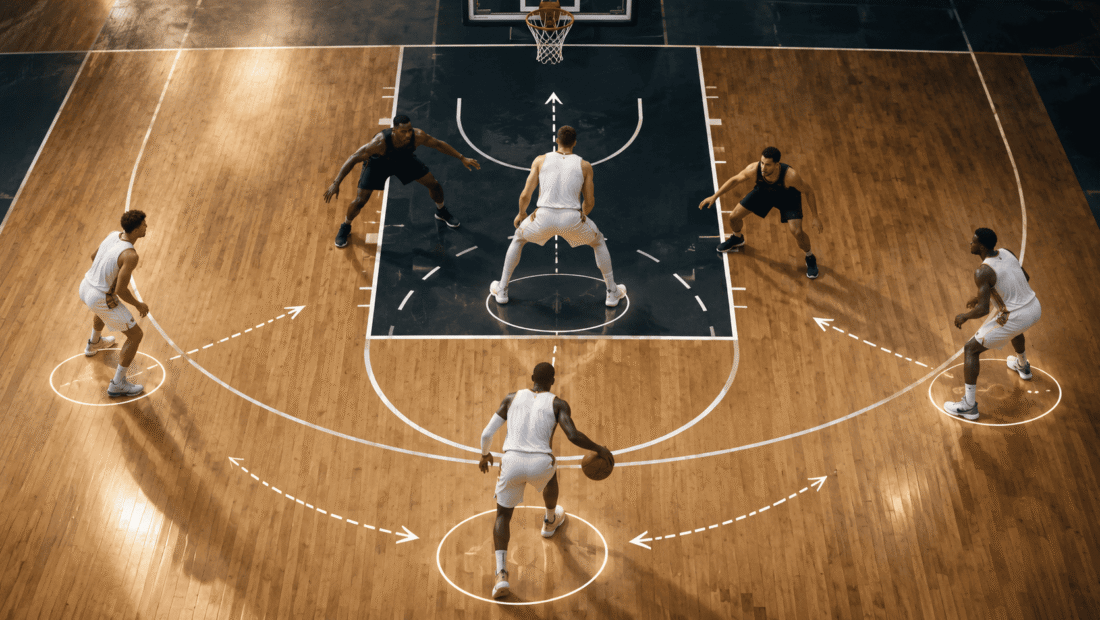
Basketball traditionally divides a lineup into five positions: point guard, shooting guard, small forward, power forward and center. Those labels remain useful because they describe common responsibilities, but modern basketball has made the boundaries between positions much less rigid. Guards can rebound and defend larger opponents, centers can initiate offense from the perimeter, and forwards frequently handle the ball in ways that once belonged almost exclusively to point guards.
Understanding basketball positions therefore means learning both the traditional framework and the roles players actually perform. A player listed at one position may have very different responsibilities from another player with the same label, depending on team structure, teammates and coaching philosophy.
The five-position system is best treated as a starting point for understanding basketball rather than a strict set of rules.
The Five Traditional Basketball Positions
A conventional basketball lineup uses one player at each of five positions:
| Position | Traditional role |
|---|---|
| Point Guard | Ball handling and playmaking |
| Shooting Guard | Perimeter scoring and shooting |
| Small Forward | Versatile scoring and wing play |
| Power Forward | Interior play, rebounding and physical defense |
| Center | Rim protection, rebounding and inside scoring |
These descriptions explain why the positions received their traditional identities, but today’s NBA and other high-level competitions frequently blur the distinction.
Some teams effectively use multiple guards capable of running the offense. Others deploy forwards as primary creators or centers who spend significant time outside the paint.
What matters most is not the label beside the player’s name, but the responsibilities that player performs when the game begins.
What Does a Point Guard Do?
The point guard has traditionally been responsible for organizing the offense.
That often means bringing the ball up the court, initiating offensive actions and creating scoring opportunities for teammates. Point guards frequently operate in pick-and-roll situations because they can use a screen to attack the defense, find the screener or pass to shooters when defenders rotate.
Decision-making is therefore one of the position’s most important skills.
A point guard needs to recognize defensive coverage quickly and decide whether to pass, shoot or continue the possession. Assist numbers can reflect playmaking, but they do not capture every useful decision.
Modern point guards can also be major scorers. Some teams build their offense around guards who combine high-level passing with the ability to create shots themselves.
What Does a Shooting Guard Do?
The shooting guard traditionally plays alongside the point guard and provides additional perimeter scoring.
As the name suggests, outside shooting has historically been central to the role. A shooting guard who forces defenders to respect the three-point line can create additional space for teammates even when they do not receive the ball.
But the role extends beyond shooting.
Many shooting guards attack closeouts, create shots from the dribble and defend opposing perimeter players. Some can handle enough playmaking responsibility to operate as secondary point guards.
This is one reason the distinction between point guard and shooting guard has become less obvious.
Instead of thinking only in terms of position, analysts often consider whether a guard is primarily a creator, scorer, shooter or defender.
What Does a Small Forward Do?
Small forwards have traditionally occupied one of the most versatile positions on the court.
They are generally expected to operate both on the perimeter and closer to the basket, depending on the team’s system. A small forward may defend several positions, run in transition, shoot from outside and create offense from the dribble.
That versatility makes the position difficult to describe through one statistical category.
One small forward might function primarily as a scorer. Another can become the team’s leading defender. A third may effectively run the offense despite technically being listed as a forward.
Modern basketball increasingly uses the term wing for many players who would traditionally fall into the shooting guard or small forward categories.
What Does a Power Forward Do?
The traditional power forward played closer to the basket than the small forward and contributed through rebounding, screens, interior scoring and physical defense.
Modern spacing has dramatically changed the role.
Many power forwards now spend substantial time behind the three-point line because outside shooting creates more room near the basket. A forward capable of defending larger players while also stretching the floor can dramatically change the geometry of an offense.
Others operate as screeners, short-roll passers or small-ball centers.
As a result, the modern power forward often needs a combination of size and mobility rather than purely interior strength.
What Does a Center Do?
The center is traditionally the largest player on the floor and operates around the basket at both ends.
Defensively, centers frequently protect the rim, contest shots and secure rebounds. Offensively, they can set screens, finish near the basket and create second-chance opportunities through offensive rebounding.
But the modern center position contains several very different player types.
One center may specialize in rim protection and finishing. Another can shoot three-pointers and pull opposing big men away from the basket. Some elite centers can pass and create offense from the post or top of the key.
This versatility has made it increasingly difficult to evaluate centers only through points and rebounds.
Why Basketball Positions Have Become More Flexible
Traditional positions developed partly because teams benefited from assigning different responsibilities according to player size and skill.
Modern offenses increasingly prioritize spacing, switching and multiple playmakers.
If several players can dribble, pass and shoot, the offense becomes less dependent on one traditional point guard. If defenders can guard several positions, teams gain more options when switching screens.
This has produced terms such as positionless basketball.
The phrase does not mean positions have disappeared completely. Size and skill differences still influence roles. It means teams increasingly value players who can perform responsibilities traditionally associated with several positions.
What Is a Combo Guard?
A combo guard combines characteristics of the point guard and shooting guard positions.
They may score efficiently while also handling significant playmaking responsibility.
Some combo guards begin possessions with the ball but spend other parts of the game operating away from it. That flexibility allows teams to use multiple creators together instead of assigning every possession to one point guard.
The label can therefore describe a player’s role more accurately than simply calling them a one or a two.
What Is a Wing in Basketball?
The term wing is commonly used for perimeter players who fall somewhere around the traditional shooting guard and small forward positions.
Wings often need to shoot, defend and attack open space.
A highly valuable wing can provide strong perimeter defense without requiring the offense to be built around them. Others become primary scorers or creators.
Because opposing offenses frequently use multiple perimeter threats, versatile wing defenders have become particularly important.
Their value comes partly from being able to remain useful across different matchups.
What Is a Stretch Four?
A stretch four is generally a power forward whose shooting ability forces defenders to guard farther away from the basket.
That spacing can create more room for drives, post play and pick-and-roll actions.
The term became especially important as three-point shooting expanded across basketball.
Traditional power forwards could operate largely inside, but an outside shooter at the position changes defensive decisions because the opposing forward cannot simply remain near the rim.
The concept can also extend to centers, sometimes described as stretch bigs or stretch fives.
What Is a Small-Ball Center?
Small-ball lineups use a player who may be shorter or lighter than a traditional center but offers advantages through mobility, shooting or switching defense.
The trade-off is often between size and flexibility.
A smaller center may defend pick-and-roll actions more aggressively or space the floor better, while potentially giving up rebounding or interior size against larger opponents.
Whether the approach works depends heavily on matchup and personnel.
This is another example of why the position listed on a roster does not always describe what a player will actually do during the game.
How Positions Affect Defense
Defensive roles can differ significantly from offensive positions.
A player listed as a point guard may not defend the opposing point guard if another teammate is better suited to the matchup.
Teams frequently assign their best perimeter defender to the opponent’s strongest scorer regardless of listed position.
Switching defenses blur those assignments even further because players may need to guard several different opponents within one possession.
Centers traditionally protect the paint, but some defensive systems ask them to switch onto guards or defend much farther from the basket.
This makes positional versatility particularly valuable.
Why Height Does Not Determine Position by Itself
Height influences basketball roles, but it does not automatically determine position.
Two players of similar height can have completely different responsibilities based on ball handling, shooting, speed, strength and defensive ability.
A tall player with elite passing and dribbling may initiate offense. A shorter but physically strong player may defend much larger opponents.
Skill set and team structure therefore matter alongside body size.
This is especially true in modern professional basketball, where players increasingly develop abilities that once belonged mostly to other positions.
How to Identify a Player’s Real Role
Instead of relying only on the roster label, watch what the player actually does during possessions.
Who brings the ball up the floor? Who initiates pick-and-rolls? Who sets screens? Who protects the rim? Which players defend the strongest opposing scorers? Who spaces the floor from the corners?
Those responsibilities reveal more about the functional role.
Statistics can provide additional clues. High assist volume may indicate creation responsibility, while rebounding and blocks can point toward interior roles. Three-point volume can demonstrate spacing responsibility.
But numbers work best when combined with game context.
Basketball Positions Are a Framework, Not a Restriction
Point guard, shooting guard, small forward, power forward and center remain useful terms because they give fans a common language for describing a lineup.
Modern basketball simply asks more from players than those five labels once suggested.
A center may be a playmaker. A forward may effectively run the offense. A guard may defend larger players. Several teammates can share responsibilities that previously belonged to one position.
Understanding both the traditional structure and these modern variations makes NBA lineups, trades and tactical changes much easier to interpret.
The question is no longer only “What position does this player play?”
Often, the more useful question is “What role does this player perform for this team?”